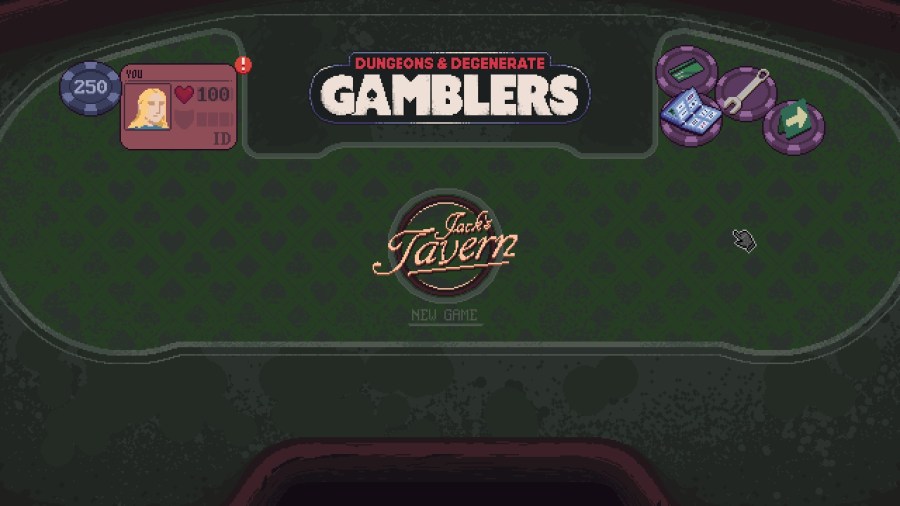
Ya know, reader, I passed up on Balatro because it took off so fast, and everyone was playing it that I was burnt out and did not want to buy it. Every streamer that I watched had the game up on their screen, and it was exhausting to see the game everywhere. Now that the storm has calmed I think that I am able to get back into the deckbuilding/real card game genre with this week’s game. The game gives you a lot to learn and a lot of variance to try and control, and it comes out as an interesting take on the genre. This week is Dungeons & Degenerates: GAMBLERS (D&D:G).
Dungeons & Degenerates: GAMBLERS (D&D:G) is a blackjack-inspired deckbuilding roguelike from Purple Moss Collectors that was published by Yogscast Games. The game was released in August for the PC and retails for $15. I want to personally thank the developer and publisher for the key.
Where else would begin your D&D adventure than in a tavern? In this specific tavern, the people play a wacky, super-corrupt version of blackjack that borderlines absolute absurdity. Gotta make your way through the multiple areas to win the video game.
The game starts with choosing a suit, and those suits have different effects when hitting blackjack with that suit. Hearts heal, diamonds give you more chips, spades add a shield, and clubs add damage. Take a deck of one of each card (two through Ace) and are on your way.
Easy Right?
If you are familiar with the baseline rules of blackjack, then you are off to a great start. You are then introduced to an opponent that you will have to battle to advance throughout the levels. Opposing blackjack players have HP, a predetermined number that they will stand at and a deck all their own. The tutorial is literally just the bartender, and you are introduced to how the “combat” works in D&D:G.
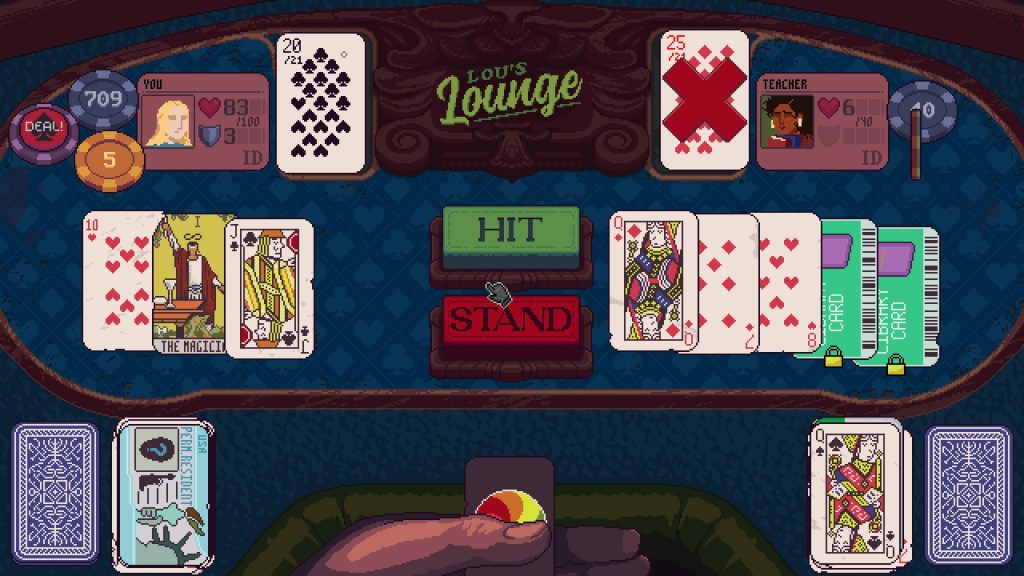
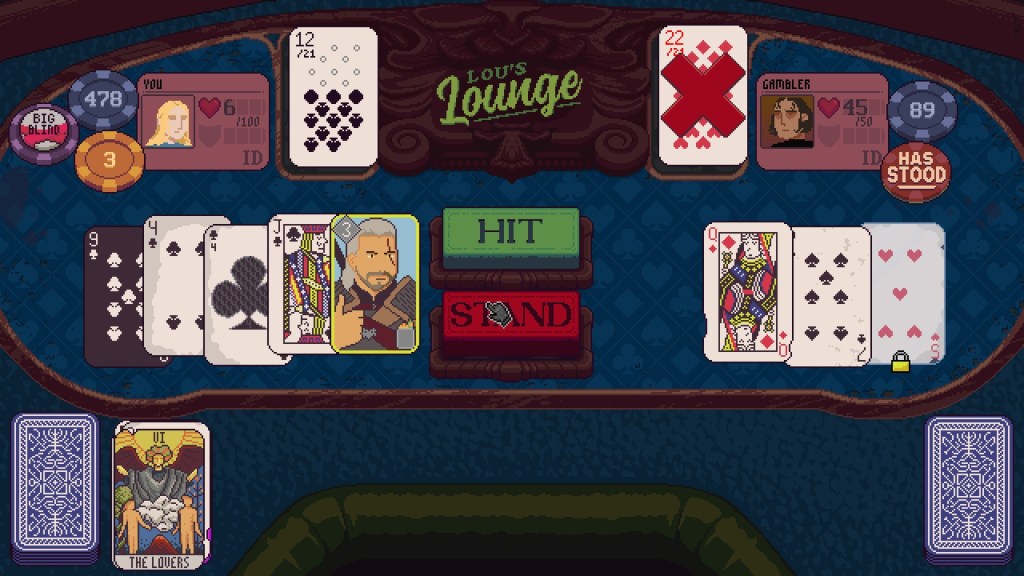
The easiest way to put it is: you play blackjack, and when each player stands, the difference between the total is dealt in damage to the player with the lowest stand. Do that over and over until the player or the opponent’s health drops to zero. The key here is that if you bust, then it is an automatic zero, meaning that if your opponent stood at 17 and you were greedy and bust, then you are taking 17 whole damage, and the player starting at 100 HP helps when making little mistakes in the beginning.
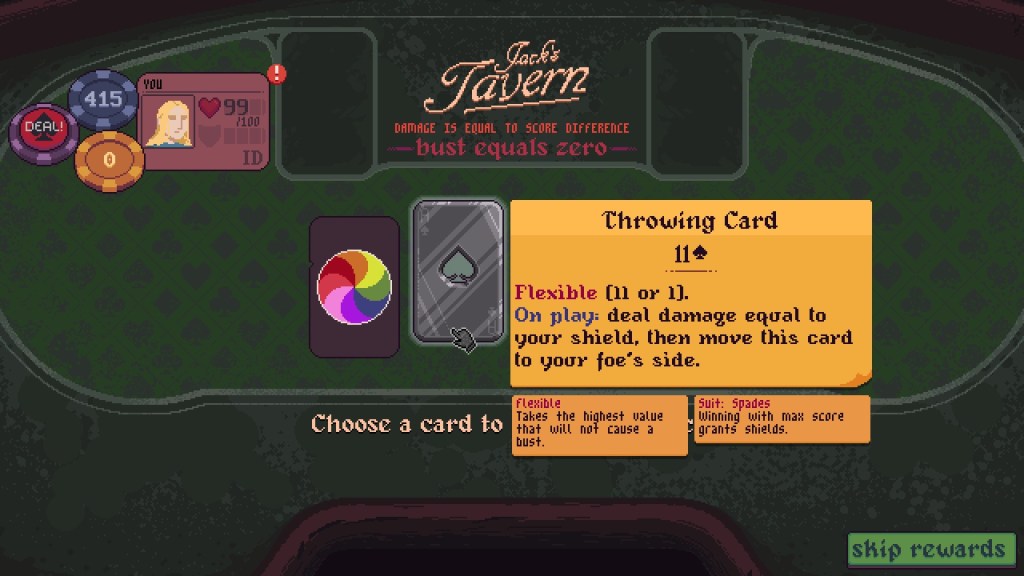
Once you complete the “tutorial,” D&D:G sends you to the reward screen to pick a card, and you will soon know that you aren’t playing with just suited cards but with library cards, social security cards, and a BUNCH OF OTHER CARDS. You are also introduced to “advantage,” which is a currency used to play cards from outside your deck or in your hand that abilities sometimes contain.
Then, off you go into the weird, luck-based adventure filled with fascinating creatures, bonkers-looking cards, and sometimes infuriating battles.
The non-suit cards have loads of different abilities: locking cards to be used the next turn, burning cards to remove cards from the game, On Hit and On Stand abilities, On Discard, cards that move to the opponent side, cards that switch sides, cards that can be any value and cards that subtract instead of add values. There is just so much to choose from to build your deck and take you all the way through the game.
precursor to each battle lets the player choose if they want to do an event like sleep and restore some HP, buy cards at a shop, or remove cards. Pretty much all things you find in a deck builder.


Battles are sometimes quick, and sometimes they are a slog if you don’t have the right cards for the fight. There were moments when I was losing in the first few fights because the NPC was hitting past their stand limit three, even four times in a row, taking me down to sub-50 HP in the first area. After you take the opponent down to 0, you are rewarded with some chips to buy cards and a choice of four cards to add to your deck.
Variance is a huge part of this game, and it shows, but the game doesn’t reciprocate it in a way of managing just how well of a run your opponents have sometimes. There are lock and burn cards, but if you don’t see them, then you are sure to lose, making losing feel really, really bad.
It’s not all bad, though; there are moments when your deck really clicks, and it gets you really far into the game, and it is a blast to play. That has only happened once, and it happened to a deck that my wife built. Plus, there is a bunch of replayability as there are a bunch of cards to collect (300 or something), and it seems like there are seemingly endless decks to build.
When it works, but when it doesn’t, I really just wanted to reset.
D&D:G has those pixels that make the art look great, and I really like the look. The game looks grimy when you enter the basement and play blackjack against the rats, and looks really nice when you enter Lou’s Lounge. Everything is super colorful, and some of the art on the cards has me laughing both at the art and the abilities.
The soundtrack is good enough for me. The music matches where you currently are. When in the basement, the music is equally as grimy as the beings that inhabit it. The music has that lightweight feel to it, making it not so much at the forefront of the game but as a nice addition while you are trying to match your way through a battle.
Dungeons & Degenerates: GAMBLERS is an interesting take on the deckbuilding genre. It takes the quirkiness of Balatro and puts its own spin on it with blackjack. It sucks that a lot of the time, I was losing to regular, non-boss decks were slaughtering me, and if it wasn’t the enemies, it was my own deck that crumbled because I didn’t have the cards to compete with the baddies.
The game is definitely fun but I wish that there was more variance control so that I could maybe fix my run before it got totally ruined twenty minutes in. Either give me a concede button early on to save me time or fix the variance.
I’ve played just about two hours of the game, and once I lose to “just not getting the right cards,” I don’t ever want to go back.
6/10
 Grinds and Games